Parabolic Partial Differential Equations
1-D, Time-Dependent Boundary Value Problems:
Finite Difference Techniques
Here we switch from studying 2-D boundary value problems to 1-D, time-dependent problems. Our two independent variables are now one spatial variable and time. As before, we will deal here with heat conduction problems, although now we'll solve time-dependent problems. In these problems, we will seek solutions for the temperature field in some 1-D region with specified boundary conditions. The governing equation for these problems is:
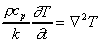
where T is the temperature, is the density,  is the heat capacity, and k is the thermal conductivity of the solid. In Cartesian
coordinates this equation becomes:
is the heat capacity, and k is the thermal conductivity of the solid. In Cartesian
coordinates this equation becomes:
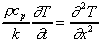 .
.
As a model problem, we'll consider a bar of length L which is initially at some
uniform temperature  . We will assume that one end of
the bar is held at that same temperature throughout the problem, but that at t=0 the
other end is changed to a new temperature
. We will assume that one end of
the bar is held at that same temperature throughout the problem, but that at t=0 the
other end is changed to a new temperature  .
.
To solve this problem numerically, we divide the bar into several regions of width h
and rewrite the equation in terms of the temperatures at each of these grid points and
at each time step. We will label each temperature using the notation  , where i denotes the mesh point and j denotes the time
step. When we difference the time derivative, we can write:
, where i denotes the mesh point and j denotes the time
step. When we difference the time derivative, we can write:
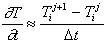
where t is the time step. This is called a forward-differencing scheme because it uses the current and next time steps. The simplest way to solve the equation is to write the spatial derivative term at the current time step, giving:
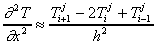
We can substitute these approximations into the partial differential equation, giving
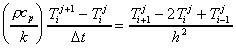
Since there is only one term in this equation represents a temperature at the next time step, we can solve for that term in terms of temperatures at the current time step. Hence,

where

This can be used to solve for all the temperatures at time step j+1, knowing the temperatures at time step j. No iteration is required. Unfortunately, there is a drawback to this method; it can be unstable if the time step and mesh spacing are not properly chosen. Specifically, we must have

in order to have a stable solution.
There is another technique that is unconditionally stable. This is the explicit technique, which is similar to the implicit technique described above except that the spatial derivative is written at the end of the step. That is,

Now we have several terms which represent temperatures at time step j+1. Solving
for  , we obtain:
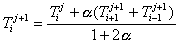
This is easily implemented in a spreadsheet, but it does require iteration. Perhaps the most versatile algorithm for solving parabolic PDE's is a combination of the explicit and implicit methods. Here we write the spatial derivative as:

giving

Solving now for  yields:
